

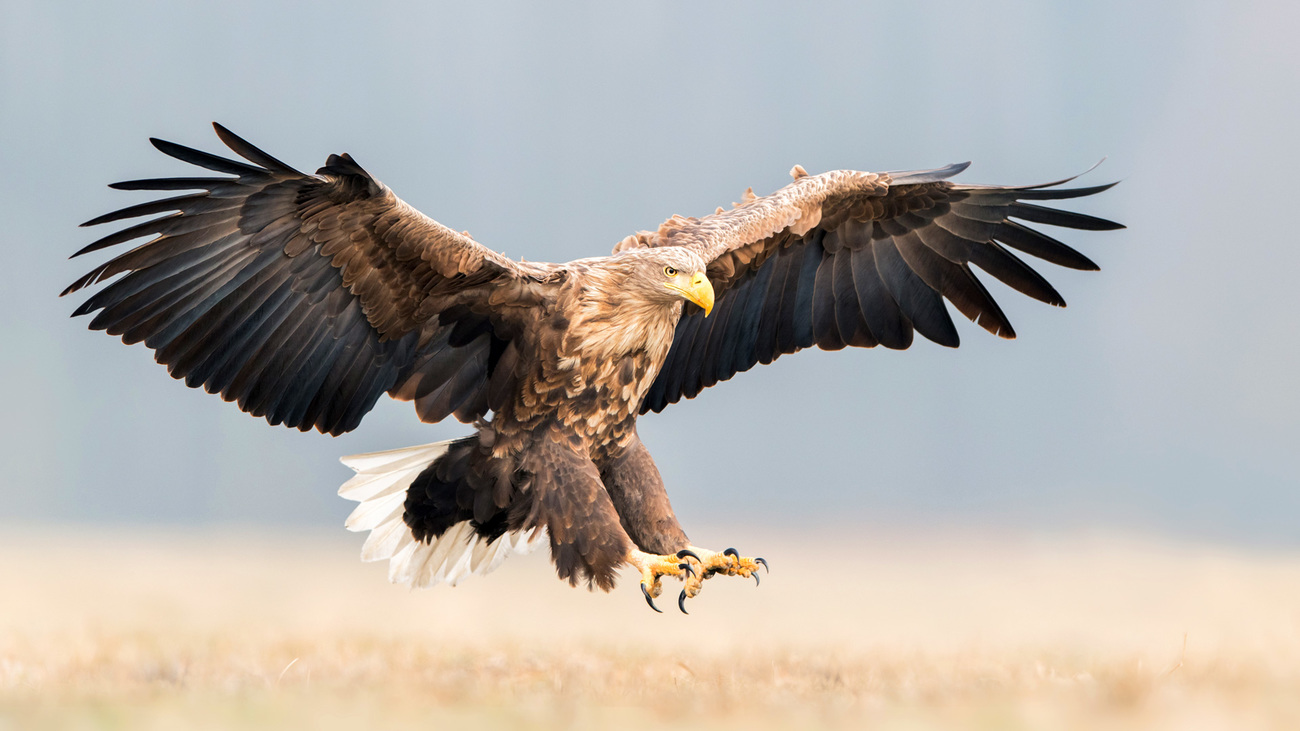
Beyaz kuyruklu kartal

Beyaz kuyruklu kartal, dünyadaki tüm kartallar arasında en uzun kanat açıklığına sahiptir. Ayrıca fırsatçı avcılardır ve sıklıkla diğer kuşlardan ve su samurlarından av çalarlar.
Uçuş halindeki beyaz kuyruklu kartal.
Uçuş halindeki beyaz kuyruklu kartal.
Deniz kartalı olarak da bilinen beyaz kuyruklu kartal, parlak beyaz kuyruğu dışında kahverengi tüylere sahip büyük bir yırtıcı kuştur. Orta, Kuzey ve Doğu Avrupa'nın yanı sıra dünyanın birçok bölgesinde ormanlarda, otlaklarda ve deniz yaşam alanlarında yaşar. Genellikle göller, nehirler ve okyanuslar da dahil olmak üzere büyük su kütlelerinin yakınında bulunurlar. Büyük pençeleriyle balık avlamak için aşağıya doğru dalış yapan en üst düzey yırtıcılardır ve aynı zamanda leşlerle beslenen leş yiyicilerdir.
4. Avrupa yılan balığı ( Anguilla anguilla )
Seçen: Frances Goodrum , İngiltere Kampanyalar ve Programlar Başkanı
Neden: Avrupa cam yılan balığı şu anda dünyada en çok kaçakçılığı yapılan hayvanlardan biri.
Bazen saydam gövdeleri nedeniyle cam yılan balığı olarak da adlandırılan Avrupa yılan balıkları, yaşadıkları tüm bölgelerde kritik derecede tehlike altındadır. Yavrularını yumurtlamak için Avrupa'dan Sargasso Denizi'ne (Bermuda civarı) iki yıl süren etkileyici bir göç gerçekleştirirler . Ne yazık ki, bu yılan balıklarının kaçakçılığı karlı bir iştir ve yasadışı kârların yaklaşık 3 milyar Euro'ya ulaştığı tahmin edilmektedir. 26 tondan fazla yılan balığının kaçakçılığının önlenmesini sağlayan büyük bir müdahale olan LAKE Operasyonu , birçoğunun doğal yaşam alanlarına geri dönmesine olanak tanıdı.
5. Akdeniz ispermeçet balinası (Physeter macrocephalus)
Seçen: Aurore Morin , Fransa Kıdemli Kampanya Sorumlusu
Neden: İspermeçet balinası, dişli balinaların en büyüğüdür ve çok yetenekli bir dalgıçtır; okyanusun derinliklerine (2000 metreye kadar!) inmek için saatlerce nefesini tutabilir. İspermeçet balinaları dikey olarak uyur ve uyurken beyinlerinin bir yarısını kapatırlar.
Akdeniz'de bir ispermeçet balinası kuyruğunu sallıyor.
Akdeniz'de bir ispermeçet balinası kuyruğunu sallıyor. Fotoğraf: Magnus Danbolt / © IFAW
Ne yazık ki, Akdeniz'deki ispermeçet balinası popülasyonu, IUCN tarafından nesli tükenme tehlikesi altında olarak değerlendirilmektedir; zira günümüzde yalnızca 200 bireyden oluştuğu tahmin edilmektedir. Akdeniz ispermeçet balinaları, gemi çarpmaları ve su altı gürültüsü nedeniyle büyük tehdit altındadır .
Hayvanları kurtarmamıza yardım edin
6. Avrupa kunduzu ( Castor fiber )
Seçen: Robert Kless , Almanya Ülke Direktörü
Neden: Gerçek bir peyzaj mühendisi gibi, birçok farklı tür için yaşam alanı yaratan barajlar inşa ediyor.
The European beaver or Eurasian beaver is found throughout western Europe, northern Europe, and the Baltic region. Unfortunately, this beaver was hunted to extinction in the UK, and its mainland population was reduced to just 1,200 individuals in 1900. Since then, the species has made a significant recovery, thanks to conservation efforts. Beavers modify their habitats more than most other animals, building dams which create floodplains. These wetlands provide habitats for many other types of animals.
7. Eurasian lynx (Lynx lynx)
Chosen by: Céline Sissler-Bienvenu, Disaster Response Program Director – Europe
Why: Lynx are Europe’s most endangered carnivores and the world’s most threatened cats. Despite being keystone species in their ecosystems, these elusive animals face constant threats: poaching, degradation of their habitat, scarcity of prey as they compete with hunters, car accidents, and a new one—natural disasters such as flooding and wildfires. Only few thousand individuals remain across the continent.
Yosunlu bir ağaç gövdesi üzerinde zıplayan bir Avrasya vaşağı yavrusu.
A Eurasian lynx cub leaping on a mossy tree trunk.
The Eurasian lynx lives across northern, central, and eastern Europe, spanning to the eastern coast of the Asian continent. The Iberian lynx (Lynx pardinus) lives only in Spain and is much more endangered—there are only 156 Iberian lynx estimated to be remaining.
8. Harbour porpoise (Phocoena phocoena)
Chosen by: Noé Swynghedauw, Campaign Officer – France
Why: The harbor porpoise is one of the smallest cetacean species. It usually lives in small groups, and surfaces quickly without showing too much of its body above the water. I find them really intriguing because of their elusive character!
Combined estimates indicate that there are more than one million harbor porpoises in the world. As a result, the species is classified globally as least concern. However, there are some notable exceptions: the Baltic Sea population is considered critically endangered, and the Black Sea population is considered endangered. There is also growing concern about the population on the Iberian Peninsula. In all three cases, fisheries bycatch is the main cause of the continuing decline in small cetacean populations.
9. Elk
Chosen by: Robert Kless, country director – Germany
Why: Known as the ‘king of the forests’, the elk is the largest and heaviest deer in the world.
Sibirya nehrinin kıyısındaki çalılıkların arasında iri bir geyik (geyik türü) duruyor.
A large elk (moose) stands among the bushes on the bank of a Siberian river.
Known as the moose in North America and the elk in Europe, this species (Alces alces) is known for its broad, open-hand shaped antlers, which males shed each year (female elk do not grow antlers). Baby elk grow incredibly fast, so by the time they are only five days old, they are large and strong enough to outrun a human. Elk can grow up to 1.8 metres (6 feet) tall and weigh 360 to 730 kilograms (800 to 1,600 pounds).
Elk live in the colder environments of northern Europe and Russia, as well as Canada and the northern US. This species is not to be confused with the species Cervus canadensis, which is called the elk in North America.
10. Mediterranean tortoises
Chosen by: Céline Sissler-Bienvenu, Disaster Response Program Director – Europe
Why: Tortoises have experienced more than 200 million years of evolution. These ectothermic animals succeeded to survive many crises so far thanks to their remarkable adaptive faculties. However, the anthropogenic climate change makes their lives harder. Although the tortoises evolved with fires In the Mediterranean basin, the new patterns of these (more frequent, more intense, faster and much challenging to fix) impact severely their populations. Being slow, with a very low escape capacity, they are highly vulnerable to disasters. In addition, given the high sympathy capital they benefit, they are victims of trafficking to be kept as pets. Unfortunately, as their behavior and needs aren’t really known by the owners, and tortoises don’t vocalize when they suffer, many of them do see their lifespan reduced from an average of 60 to 90 years in the wild to 10 to 15 in captivity.
There are six distinct types of Mediterranean tortoise: the marginated tortoise (Testudo marginata), Hermann’s tortoise (Testudo hermanni), the Asia Minor tortoise (Testudo graeca ibera), the Egyptian tortoise (Testudo kleinmanni), the Negev tortoise (Testudo werneri), and the Greek tortoise (Testudo graeca, also known as the spur-thighed or common tortoise). The marginated tortoise is listed as least concern, Hermann’s tortoise as near threatened, the Greek tortoise as vulnerable, and all of these tortoises were impacted by the wildfires that ravaged Greece in the summer of 2023.
11. Grey wolf (Canis lupus)
Chosen by: Mia Crnojevic, Senior Campaigner – France
Why: This animal is an inspiration for animal intelligence and resilience and a glimmer of hope in terms of conservation efforts across Europe. It is all the more timely to mention this species as despite the conservation success, our generation risks repeating past mistakes with this magnificent creature as voices of intolerance and dissent once again put this species at risk.
Küçük bir çayırda uluyan vahşi bir gri kurt yavrusu.
A wild grey wolf pup howling in a small meadow. Photo: © John E. Marriott 2020
Once the world’s most widely distributed mammal, the grey wolf is found in Europe, Asia, and North America, but two subspecies live in Europe—the Iberian wolf (Canis lupus signatus) and the Italian wolf (Canis lupus italicus). Wolves are apex predators, and without their presence in the ecosystem, prey species may experience out-of-control population growth, which harms vegetation and the environment as a whole. Sadly, in Europe, they were hunted almost to extinction. But since the 1960s, their population numbers have increased by almost 1,800%.
Misconceptions and fear about predators like the grey wolf impact how they are treated. IFAW works to promote coexistence with predators like wolves and to prevent inhumane lethal control methods from being used on them.
12. Alpine long-eared bat (Plecotus macrobullaris)
Chosen by: Staci McLennan, Director of Policy – Europe
Why: I’ve always loved bats. While horror movies gave them a bad name when I was growing up, I found them fascinating from the graceful way they fly through the night sky to their use of echolocation (by microbats) to navigate terrain and find food. At university in my wildlife biology lab, I was able to handle these gorgeous creatures and their furry bodies, delicate wing membranes, and soft ears were remarkable. They are a vital part of their ecosystems, and my son and I love to watch them in summer from our terrace.
The alpine long-eared bat, also called the mountain long-eared bat, is a medium-sized bat species found across Europe from France and Spain to the Middle East and the Caucasus. It is recognizable by its remarkably long ears and its white underparts. Interestingly, this bat is found high in the Alps and Pyrenees mountain ranges, but also at sea level in other areas. They also don’t seem to care much about the temperature, found in both hot and cold climates. What the alpine long-eared bat does need is rocky crevices, ledges, and crushed stones, in which they make their homes.
Donate to help save wildlife around the world
Share this article
Related content
Landscape Conservation
Blog
Seeing conservation through a woman’s eyes
Read more
Press releases
Malawi launches elephant monitoring operation in Kasungu
Read more
Blog
IFAW ekipleri 2026 Vahşi Yaşam Korucusu Yarışması'nda zorlu bir mücadeleye imza attı.
Devamını oku
Siz olmadan çalışmalarımızı tamamlayamayız. Lütfen hayvanların sağlıklı bir yaşam sürmesine yardımcı olmak için elinizden gelen yardımı yapın.
Şimdi bağış yapın
55 yılı aşkın süredir hayvanlara, insanlara ve evimiz dediğimiz yere yardım ediyoruz .
Bizi takip edin
IFAW Hakkında
Yaklaşımımız
Tarih
Darbe
Ortaklar
IFAW ekibi
Finans ve yönetişim
Bize Ulaşın
Çalışmalarımız
Koruma
Kurtarmak
Gezilecek Alan
Küresel erişim
Katılın
Harekete geçin
Destek
IFAW'a katılın
Miras hediyesi
Keşfetmek
Hayvanlar
Keşfetmek
Haberler
Kariyerler
SSS
Uluslararası Hayvan Refahı Fonu
290 Summer Street, Yarmouth Port, MA 02675 | ABD
IFAW, 501(c)(3) kar amacı gütmeyen bir kuruluştur.
Gizlilik Politikası | Kullanım Şartları | Eyalet Açıklamaları
IFAW © 2026
Çerezlerimi yönet
Kişisel bilgilerimi satmayın veya paylaşmayın.
Amerika Birleşik Devletleri
Orijinal metin
Why: The white-tailed eagle has the longest wingspan of any eagle in the world. They’re also opportunistic hunters, often stealing prey from other birds and from otters.
Beyaz kuyruklu kartal, dünyadaki tüm kartallar arasında en uzun kanat açıklığına sahiptir. Ayrıca fırsatçı avcılardır ve sıklıkla diğer kuşlardan ve su samurlarından av çalarlar. …Daha fazla göster
Beyaz kuyruklu kartal, dünyadaki tüm kartallar arasında en uzun kanat açıklığına sahiptir. Ayrıca fırsatçı avcılardır ve sıklıkla diğer kuşlardan ve su samurlarından av çalarlar.
Uçuş halindeki beyaz kuyruklu kartal.
Uçuş halindeki beyaz kuyruklu kartal.
Deniz kartalı olarak da bilinen beyaz kuyruklu kartal, parlak beyaz kuyruğu dışında kahverengi tüylere sahip büyük bir yırtıcı kuştur. Orta, Kuzey ve Doğu Avrupa'nın yanı sıra dünyanın birçok bölgesinde ormanlarda, otlaklarda ve deniz yaşam alanlarında yaşar. Genellikle göller, nehirler ve okyanuslar da dahil olmak üzere büyük su kütlelerinin yakınında bulunurlar. Büyük pençeleriyle balık avlamak için aşağıya doğru dalış yapan en üst düzey yırtıcılardır ve aynı zamanda leşlerle beslenen leş yiyicilerdir.
4. Avrupa yılan balığı ( Anguilla anguilla )
Seçen: Frances Goodrum , İngiltere Kampanyalar ve Programlar Başkanı
Neden: Avrupa cam yılan balığı şu anda dünyada en çok kaçakçılığı yapılan hayvanlardan biri.
Bazen saydam gövdeleri nedeniyle cam yılan balığı olarak da adlandırılan Avrupa yılan balıkları, yaşadıkları tüm bölgelerde kritik derecede tehlike altındadır. Yavrularını yumurtlamak için Avrupa'dan Sargasso Denizi'ne (Bermuda civarı) iki yıl süren etkileyici bir göç gerçekleştirirler . Ne yazık ki, bu yılan balıklarının kaçakçılığı karlı bir iştir ve yasadışı kârların yaklaşık 3 milyar Euro'ya ulaştığı tahmin edilmektedir. 26 tondan fazla yılan balığının kaçakçılığının önlenmesini sağlayan büyük bir müdahale olan LAKE Operasyonu , birçoğunun doğal yaşam alanlarına geri dönmesine olanak tanıdı.
5. Akdeniz ispermeçet balinası (Physeter macrocephalus)
Seçen: Aurore Morin , Fransa Kıdemli Kampanya Sorumlusu
Neden: İspermeçet balinası, dişli balinaların en büyüğüdür ve çok yetenekli bir dalgıçtır; okyanusun derinliklerine (2000 metreye kadar!) inmek için saatlerce nefesini tutabilir. İspermeçet balinaları dikey olarak uyur ve uyurken beyinlerinin bir yarısını kapatırlar.
Akdeniz'de bir ispermeçet balinası kuyruğunu sallıyor.
Akdeniz'de bir ispermeçet balinası kuyruğunu sallıyor. Fotoğraf: Magnus Danbolt / © IFAW
Ne yazık ki, Akdeniz'deki ispermeçet balinası popülasyonu, IUCN tarafından nesli tükenme tehlikesi altında olarak değerlendirilmektedir; zira günümüzde yalnızca 200 bireyden oluştuğu tahmin edilmektedir. Akdeniz ispermeçet balinaları, gemi çarpmaları ve su altı gürültüsü nedeniyle büyük tehdit altındadır .
Hayvanları kurtarmamıza yardım edin
6. Avrupa kunduzu ( Castor fiber )
Seçen: Robert Kless , Almanya Ülke Direktörü
Neden: Gerçek bir peyzaj mühendisi gibi, birçok farklı tür için yaşam alanı yaratan barajlar inşa ediyor.
The European beaver or Eurasian beaver is found throughout western Europe, northern Europe, and the Baltic region. Unfortunately, this beaver was hunted to extinction in the UK, and its mainland population was reduced to just 1,200 individuals in 1900. Since then, the species has made a significant recovery, thanks to conservation efforts. Beavers modify their habitats more than most other animals, building dams which create floodplains. These wetlands provide habitats for many other types of animals.
7. Eurasian lynx (Lynx lynx)
Chosen by: Céline Sissler-Bienvenu, Disaster Response Program Director – Europe
Why: Lynx are Europe’s most endangered carnivores and the world’s most threatened cats. Despite being keystone species in their ecosystems, these elusive animals face constant threats: poaching, degradation of their habitat, scarcity of prey as they compete with hunters, car accidents, and a new one—natural disasters such as flooding and wildfires. Only few thousand individuals remain across the continent.
Yosunlu bir ağaç gövdesi üzerinde zıplayan bir Avrasya vaşağı yavrusu.
A Eurasian lynx cub leaping on a mossy tree trunk.
The Eurasian lynx lives across northern, central, and eastern Europe, spanning to the eastern coast of the Asian continent. The Iberian lynx (Lynx pardinus) lives only in Spain and is much more endangered—there are only 156 Iberian lynx estimated to be remaining.
8. Harbour porpoise (Phocoena phocoena)
Chosen by: Noé Swynghedauw, Campaign Officer – France
Why: The harbor porpoise is one of the smallest cetacean species. It usually lives in small groups, and surfaces quickly without showing too much of its body above the water. I find them really intriguing because of their elusive character!
Combined estimates indicate that there are more than one million harbor porpoises in the world. As a result, the species is classified globally as least concern. However, there are some notable exceptions: the Baltic Sea population is considered critically endangered, and the Black Sea population is considered endangered. There is also growing concern about the population on the Iberian Peninsula. In all three cases, fisheries bycatch is the main cause of the continuing decline in small cetacean populations.
9. Elk
Chosen by: Robert Kless, country director – Germany
Why: Known as the ‘king of the forests’, the elk is the largest and heaviest deer in the world.
Sibirya nehrinin kıyısındaki çalılıkların arasında iri bir geyik (geyik türü) duruyor.
A large elk (moose) stands among the bushes on the bank of a Siberian river.
Known as the moose in North America and the elk in Europe, this species (Alces alces) is known for its broad, open-hand shaped antlers, which males shed each year (female elk do not grow antlers). Baby elk grow incredibly fast, so by the time they are only five days old, they are large and strong enough to outrun a human. Elk can grow up to 1.8 metres (6 feet) tall and weigh 360 to 730 kilograms (800 to 1,600 pounds).
Elk live in the colder environments of northern Europe and Russia, as well as Canada and the northern US. This species is not to be confused with the species Cervus canadensis, which is called the elk in North America.
10. Mediterranean tortoises
Chosen by: Céline Sissler-Bienvenu, Disaster Response Program Director – Europe
Why: Tortoises have experienced more than 200 million years of evolution. These ectothermic animals succeeded to survive many crises so far thanks to their remarkable adaptive faculties. However, the anthropogenic climate change makes their lives harder. Although the tortoises evolved with fires In the Mediterranean basin, the new patterns of these (more frequent, more intense, faster and much challenging to fix) impact severely their populations. Being slow, with a very low escape capacity, they are highly vulnerable to disasters. In addition, given the high sympathy capital they benefit, they are victims of trafficking to be kept as pets. Unfortunately, as their behavior and needs aren’t really known by the owners, and tortoises don’t vocalize when they suffer, many of them do see their lifespan reduced from an average of 60 to 90 years in the wild to 10 to 15 in captivity.
There are six distinct types of Mediterranean tortoise: the marginated tortoise (Testudo marginata), Hermann’s tortoise (Testudo hermanni), the Asia Minor tortoise (Testudo graeca ibera), the Egyptian tortoise (Testudo kleinmanni), the Negev tortoise (Testudo werneri), and the Greek tortoise (Testudo graeca, also known as the spur-thighed or common tortoise). The marginated tortoise is listed as least concern, Hermann’s tortoise as near threatened, the Greek tortoise as vulnerable, and all of these tortoises were impacted by the wildfires that ravaged Greece in the summer of 2023.
11. Grey wolf (Canis lupus)
Chosen by: Mia Crnojevic, Senior Campaigner – France
Why: This animal is an inspiration for animal intelligence and resilience and a glimmer of hope in terms of conservation efforts across Europe. It is all the more timely to mention this species as despite the conservation success, our generation risks repeating past mistakes with this magnificent creature as voices of intolerance and dissent once again put this species at risk.
Küçük bir çayırda uluyan vahşi bir gri kurt yavrusu.
A wild grey wolf pup howling in a small meadow. Photo: © John E. Marriott 2020
Once the world’s most widely distributed mammal, the grey wolf is found in Europe, Asia, and North America, but two subspecies live in Europe—the Iberian wolf (Canis lupus signatus) and the Italian wolf (Canis lupus italicus). Wolves are apex predators, and without their presence in the ecosystem, prey species may experience out-of-control population growth, which harms vegetation and the environment as a whole. Sadly, in Europe, they were hunted almost to extinction. But since the 1960s, their population numbers have increased by almost 1,800%.
Misconceptions and fear about predators like the grey wolf impact how they are treated. IFAW works to promote coexistence with predators like wolves and to prevent inhumane lethal control methods from being used on them.
12. Alpine long-eared bat (Plecotus macrobullaris)
Chosen by: Staci McLennan, Director of Policy – Europe
Why: I’ve always loved bats. While horror movies gave them a bad name when I was growing up, I found them fascinating from the graceful way they fly through the night sky to their use of echolocation (by microbats) to navigate terrain and find food. At university in my wildlife biology lab, I was able to handle these gorgeous creatures and their furry bodies, delicate wing membranes, and soft ears were remarkable. They are a vital part of their ecosystems, and my son and I love to watch them in summer from our terrace.
The alpine long-eared bat, also called the mountain long-eared bat, is a medium-sized bat species found across Europe from France and Spain to the Middle East and the Caucasus. It is recognizable by its remarkably long ears and its white underparts. Interestingly, this bat is found high in the Alps and Pyrenees mountain ranges, but also at sea level in other areas. They also don’t seem to care much about the temperature, found in both hot and cold climates. What the alpine long-eared bat does need is rocky crevices, ledges, and crushed stones, in which they make their homes.
Donate to help save wildlife around the world
Share this article
Related content
Landscape Conservation
Blog
Seeing conservation through a woman’s eyes
Read more
Press releases
Malawi launches elephant monitoring operation in Kasungu
Read more
Blog
IFAW ekipleri 2026 Vahşi Yaşam Korucusu Yarışması'nda zorlu bir mücadeleye imza attı.
Devamını oku
Siz olmadan çalışmalarımızı tamamlayamayız. Lütfen hayvanların sağlıklı bir yaşam sürmesine yardımcı olmak için elinizden gelen yardımı yapın.
Şimdi bağış yapın
55 yılı aşkın süredir hayvanlara, insanlara ve evimiz dediğimiz yere yardım ediyoruz .
Bizi takip edin
IFAW Hakkında
Yaklaşımımız
Tarih
Darbe
Ortaklar
IFAW ekibi
Finans ve yönetişim
Bize Ulaşın
Çalışmalarımız
Koruma
Kurtarmak
Gezilecek Alan
Küresel erişim
Katılın
Harekete geçin
Destek
IFAW'a katılın
Miras hediyesi
Keşfetmek
Hayvanlar
Keşfetmek
Haberler
Kariyerler
SSS
Uluslararası Hayvan Refahı Fonu
290 Summer Street, Yarmouth Port, MA 02675 | ABD
IFAW, 501(c)(3) kar amacı gütmeyen bir kuruluştur.
Gizlilik Politikası | Kullanım Şartları | Eyalet Açıklamaları
IFAW © 2026
Çerezlerimi yönet
Kişisel bilgilerimi satmayın veya paylaşmayın.
Amerika Birleşik Devletleri
Orijinal metin
Why: The white-tailed eagle has the longest wingspan of any eagle in the world. They’re also opportunistic hunters, often stealing prey from other birds and from otters.










0 Yorum